Showing posts with label nissan. Show all posts

Wednesday, 26 February 2014

2014 Nissan GT-R Track Edition


SPECIFICATIONS

1. 2014 models continue to be powered by a twin-turbo 3.8L V6 engine making 545 hp and 463 lb-ft of torque.
2. The 2014 GT-R starts at about $100,000 with the Track Edition almost at $116,710 including destination.
3. Upgrades include a more rigid body, revised suspension tuning and an even more responsive engine plus carbon fiber brake-cooling ducts and a rear seat delete.
4. Just 150 Track Edition models will be available in the US.

PREVIEW

Track Edition models are limited to the United States and they’re only building 150 of them, which makes a special car even more unique.
Regular GT-Rs benefit from a more responsive engine at high RPM thanks to new fuel injectors, a retuned suspension and a more rigid body. One snazzy feature is the addition of a placard on the engine that bears the craftsman’s name that built it… by hand. The engine-assembly process takes a full six hours and is completed by one of four people. These gentlemen are called “takumi” in Japanese, which apparently means master craftsman. This hands-on approach is done to guarantee precision and quality.

INTERIOR

Called the Track Edition this limited-production version features a unique suspension setup, brake-cooling ducts and no rear seats. The back chairs are replaced with quilted cloth mats where the cushions used to be. I’m not kidding. There’s also fancy new leather inside the car as well some carbon-fiber additions. Of course these enhancements are in addition to upgrades the “standard” GT-R has received.
2014 Nissan GT-R Track Edition

UNDER THE HOOD

From the driver’s seat (or any seat for that matter) it’s easy to tell the GT-R Track Edition is a beast. The way it sounds, turns and stops is utterly astounding.
Nailing the throttle from a standstill results in a somewhat tepid launch. But once the engine gets a few revs on the clock and the duet of turbos is spooled up, hang on. At around 3,200 RPM the car explodes like a fertilizer plant in a wildfire, which sends you – and your passengers – hurtling down the road at felony speeds.The car is propelled by a 3.8-liter V6 engine with an iron lung (read: turbocharger) hanging off each cylinder bank. The result is a monstrous 545 horsepower with 463 lb-ft of torque. It’s matched to a six-speed dual-clutch automatic transmission and a cutting-edge all-wheel drive system that can rout 100 percent of the engine’s torque to the rear wheels or up to 50 percent to the front axle.
At peak power the G-forces at play are so strong it almost makes it feel like you’re having an asthma attack. It gets slightly harder to breathe as the engine presses your carcass into the seat until you get a split-second reprieve as the transmission grabs the next gear. Have you heard of sleep apnea before? Perhaps doctors will diagnose GT-R owners with driving apnea. The GT-R should come with a CPAP machine.
Read Full Review

Tuesday, 25 February 2014

Nissan Leaf


SPECIFICATIONS

1. An 80 kW AC motor generates 107 horsepower and 187 lb-ft of torque.
2. The Leaf is rated at 129 MPGe city and 102 MPGe highway with a range around 75 miles.
3. The base price of the Leaf SL is $34,840 with our test vehicle coming in at $36,740 after destination charges.
4. Despite being an electric vehicle, there is still 24 cu-ft of rear cargo space.

PREVIEW

Many said it would never happen. The electric car would never work, people would not buy them and vehicles like the Nissan Leaf were doomed from the start. Someone should have told Nissan.
Now entering its third year of production, the Leaf isn’t just surviving but actually gaining momentum. For each of the past two years, roughly 9,500 Leafs were sold. This year through September, over 16,000 Leafs have already left showroom floors and it’s on pace to outsell the past two years combined.
The reason for this sales surge is two-part. First, for 2013 prices were slashed and a new more basic Leaf was introduced. The S trim starts at $28,800 before incentives, which is over $6,000 cheaper than the base 2012 Nissan Leaf. The SV and SL trims have also received price reductions this year, dropping by $3,380 and $2,410 respectively.

INTERIOR

Our test vehicle arrived as the Leaf SL with the premium package that added Nissan’s great “Around View” Monitor and a seven-speaker Bose audio system. This bumps the $34,840 base price up to an as-tested figure of $36,740 after destination charges. For 2013, the SL also receives leather seats and 17-inch aluminum-alloy wheels to go with the usual upgrades of LED headlights, fog lights, cargo cover and quick charge port spoiler mounted solar panel.
The Leaf is officially rated as a mid-size car thanks to generous interior room even if an overall length of 175-inches makes it shorter than the Nissan Versa sedan. Unlike other electric vehicles that have been converted from a regular car, the Leaf was designed as an electric car from the ground up. This means there is a decent 33.3-inches of rear legroom and a deep, 24 cubic-foot cargo hatch.  The rear seats also fold flat allowing the storage of a lot of gear when needed.

Even if the Leaf may pass off as a regular on the inside, it doesn’t on the outside. Looking a bit like a frog thanks to the upward protruding headlights, there is no mistaking the it on the road for anything else and no missing that it’s an EV. It’s not as extreme as the Mitsubishi i-MiEV, but those looking for a subtler electric car will want to look somewhere else.
Nissan Leaf

UNDER THE HOOD

As a quick recap, the Leaf uses a 24 kWh lithium-ion battery pack paired to an 80 kW AC motor that generates 107 horsepower and 187 lb-ft of torque. A single speed reducer sends power to the front wheels and allows the Leaf to achieve 129 MPGe city and 102 MPGe highway fuel economy equivalency rating. These are high enough numbers to trump both the Ford Focus EV and Mitsubishi i-MiEV all-around, as well as the Chevrolet Spark EV in city, but not on the highway.

Now 107 hp may not sound like much for a 3,340 lb car, but the instantaneous, seamless torque more than makes up for it. The Leaf accelerates swiftly around town, but does lack enough grunt for untimed highway passes.
In “B” mode, the regenerative brakes become more aggressive and work to maximize range. After a small adjustment, I was able to fully exploit them to perform the majority of my braking while also extending my range. When driven mildly, I was achieving 75-78 miles, which is right on the official estimates. Driven like a lunatic escaping imaginary enemies, my range dropped to about 60 miles.
Read Full Review

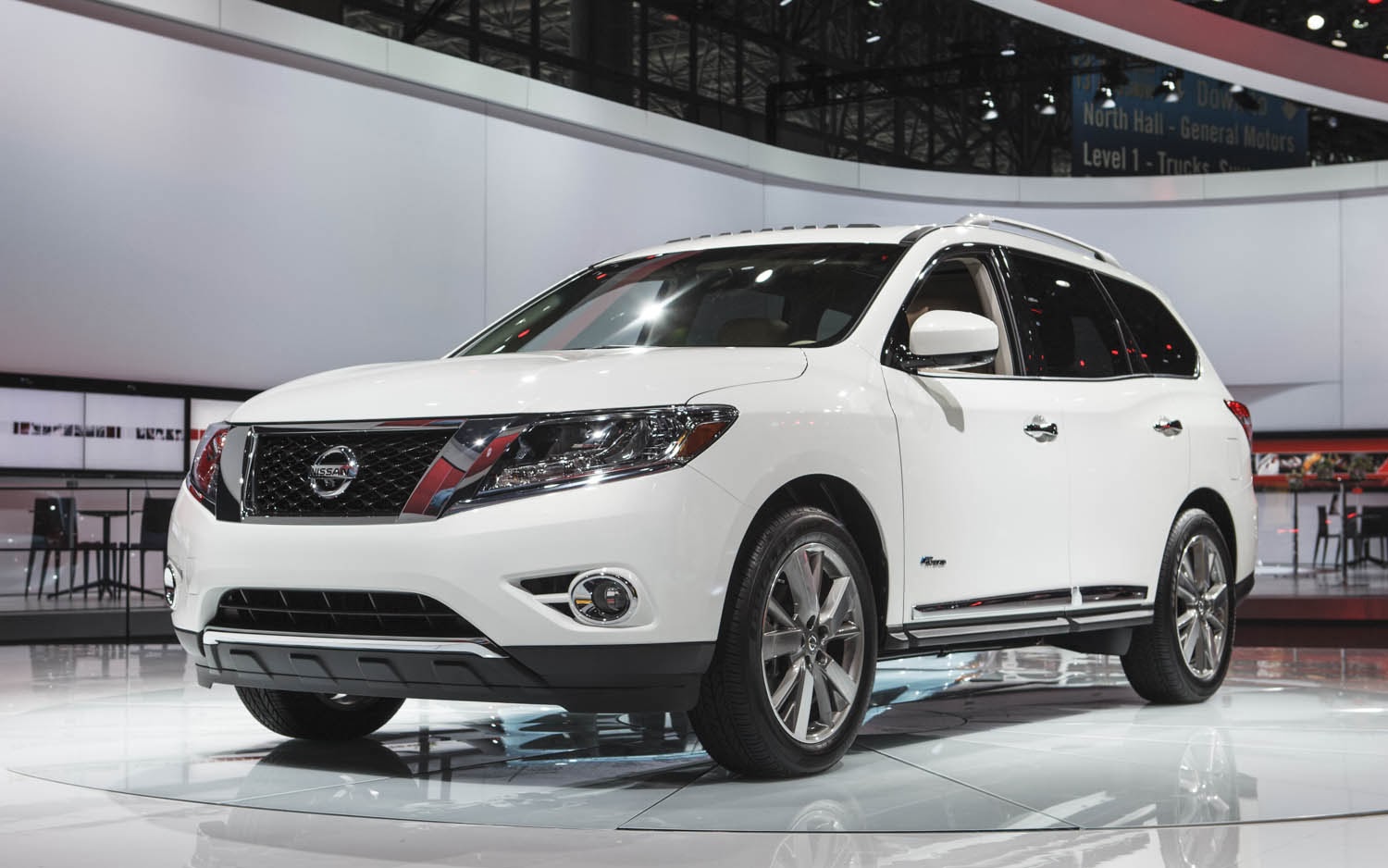
2014 Nissan Pathfinder Hybrid


SPECIFICATIONS

1. Hybrid pathfinders are powered by a supercharged 2.5L 4-cylinder mated to a 15 kW electric motor and lithium-ion battery pack to produce 250 hp and 243 lb-ft of torque.
2. Fuel economy is rated at 25 MPG city and 28 MPG highway for FWD models (25/27 for AWD), roughly a 25 percent improvement over the V6.
3. With no base S model, the Pathfinder Hybrid SV starts at $35,970 or roughly $3,000 more than the equivalent V6 model.

PREVIEW

There are some who are still smarting over Nissan's decision to turn the Pathfinder from an off-roader into a soft-roader in 2013. Those same people will probably defecate kittens when they learn that the Pathfinder will be available in a hybrid version for 2014.


INTERIOR

And on that, the Pathfinder Hybrid does indeed deliver. The vehicle we tested was a top-of-the-line Platinum model stuffed with every feature the Pathfinder offers, including buttery-soft leather seats, a power tailgate, Bose stereo, and touch-screen navigation. The Pathfinder Hybrid offers an active noise cancellation system, and it did a stellar job keeping the interior as quiet as a library. It's a very nice vehicle -- so nice we have to wonder how Nissan plans to sell the Infiniti version (the QX60, formerly known as the JX35).

Size-wise, the Pathfinder feels bigger than the Toyota Highlander, which happens to be the only other seven-seat SUV to offer a hybrid option. In terms of seating, it's closer to the General Motors Lambda triplets (Buick Enclave, Chevrolet Traverse, GMC Acadia), with a third-row seat that is tight but useable, plus 16 cubic feet of cargo space with all three rows in place. But the Pathfinder doesn’t feel as large or ungainly as the Lambdas, and it's far easier to park, especially when equipped with the Around View Monitor, which uses strategically mounted cameras to give a virtual overhead view.

2014 Nissan Pathfinder Hybrid


UNDER THE HOOD

The Pathfinder Hybrid's drivetrain is built around a supercharged (yes, supercharged!) version of Nissan's 2.5 liter four-cylinder engine. A 15 kW electric motor is sandwiched between the gas engine and the Pathfinder's CVT automatic transmission, adding 20 horsepower to the engine's 230 for a total system output of 250 hp (ten fewer than the V6-powered Pathfinder).
A pair of clutches separates the three elements, which allows electric motor to power the Pathfinder Hybrid independently of the gasoline engine. (It also allows Nissan to sneak the phrase "dual clutch" into their PR and marketing materials, though the Pathfinder Hybrid's arrangement has nothing to do with the dual-clutch transmissions found in performance and economy cars.)
From the transmission back, the drivetrain is identical to that in the V6-powered Hybrid, including optional "4x4-i" all-wheel-drive system. The electric motor draws its power from a 144-volt lithium ion battery pack that fits under the third row seat, and since the Pathfinder was designed from the get-go with a hybrid option, there is no impact on interior space. Towing capacity is reduced, however, from 5,000 lbs to just 3,500 lbs.
EPA fuel economy estimates are 25 MPG city and 28 MPG highway for front-wheel-drive versions and 25/27 with all-wheel-drive, a significant step up from the V6-powered models, which are rated at 20/26 and 19/25.
Read Full Review

2014 Nissan 370Z


SPECIFICATIONS

1. Nissan cut the price for 2014 by just over $3,000 to $30,800.
2. The as-tested Touring model with a sport package and extras costs $41,260.
3. Nissan offers a six-speed manual or seven-speed automatic.
4. EPA estimates suggest 18 mpg city, 26 mpg highway.

PREVIEW

When we heard that Nissan was dropping the price of the 370Z to $29,990 ($30,800 with destination fee) for 2014, we just had to review it. Our goal: To see if Nissan could deliver the true "Z experience" in a stripped-down car.
That said, the stripped-down Z hasn't actually been stripped down; Nissan simply slashed the price by three grand. The $30,000 base-model Z delivers gives you the same bits as last year's 370Z, including a 332 horsepower VQ-series V6 engine, six-speed manual transmission, 18-inch alloys shod with Yokohama ADVAN Sport tires, keyless entry and push-button ignition.
Alas, finding an actual $30,000 Z turned out to be a lot trickier than we expected. We had correspondents all over the US and Canada check their respective press fleets, and while most were stocked with high-end Nismos and roadsters, there was not a single cheap Z to be found.
Then we were invited to a press event near Nissan's corporate headquarters in Tennessee and we asked if there might be a base-model 370Z hanging around the office. Pay dirt! Nissan quickly agreed for us to spend a day in the car. That was easy, we thought. Too easy. Sure enough, a few days before our trip, Nissan's one and only base-model Z was in a wreck. No human casualties, but the Z was a goner.

INTERIOR

It soon became clear that the Nissan PR staffers were deathly afraid of our reaction to the base version, as if our butt cheeks might melt if they contacted a seat upholstered in something other than leather. They needn't have worried, as the base-model Z's cabin is quite a nice place: Aside from the simplified stereo, a giant storage bin in place of a navigation system, the lack of cowhide on the seats and a plastic slug where the rev-matching button normally goes, there wasn't much to differentiate the $30,000 Z from the $41,000 Sport-Touring model we drove (which, we hasten to add, has also received a price cut of $2,550).And so we came up with a compromise, which plays out in our photos. Nissan found us a white base-model Z at a friendly dealer, the interior of which we were free to poke, prod and photograph. For driving, though, we were given the red car in the photos, a $36,080 Touring model with the $3,030 Sport package, optioned up to $41,260 -- about as far away from the Base model Z as you can get without buying a Chevrolet Impala. We'd just have to turn off the rev-matching downshift feature and pretend.
2014 Nissan 370Z

UNDER THE HOOD

Sorting out the driving experience was a bit more difficult. The Sport package on our tester included larger wheels and tires, a stiffer suspension, and bigger brakes, as well as the aforementioned rev-matching gizmo for the manual transmission. We would have to draw on our experience with Zs past and essentially work downward.
The star of the show is the 3.7-liter V6 engine. The VQ, and its EPA fuel economy estimates of 18 mpg city and 26 mpg highway on premium gas, is a bit of a throwback to the days when fuel costs weren't terribly important. Nothing throw-back-ish about the performance, though: The 370Z accelerates with a soulful wail that four-cylinder turbo engines just can't recreate. And while the fuel economy figures aren't stellar, they are honest; we saw right around 19 mpg in our day of driving.
Read Full Review

Friday, 14 February 2014

Nissan Pathfinder Hybrid 2014


Specifications

1. A 2.5L supercharged four-cylinder and 15 kW electric motor make a total of 250 hp and 243 lb-ft of torque.
2. The only transmission available is Nissan’s Xtronic CVT.
3. All-wheel drive Pathfinder Hybrids are rated at 24 mpg city and 27 mpg highway.
4. The Pathfinder Hybrid starts at $35,970, but $47,510 as tested.

Preview

Nissan installed its “Intelligent Dual Clutch Hybrid System” to transform the Pathfinder into a hybrid for the first time. It consists of an electric motor that is positioned between the gasoline engine and the transmission via a pair of clutches. Unable to run on pure electric power alone, this set-up is more of an electric assist system than a full-blown two-stage hybrid. Think of it along the lines of GM’s eAssist or Honda’s IMA system.

The electric motor is a small 15 kW unit making 20 hp and 29 lb-ft. Paired to it is a new 2.5-liter supercharged four-cylinder engine making 230 hp and 243 lb-ft of torque, boosting total system output to 250 hp and 243 lb-ft of torque. That is roughly the same output as the V6 Pathfinder and like those crossovers, the only transmission choice available on the Hybrid is a continuously variable unit equipped with a standard transmission cooler.

Interior

Inside it is a similar story. The only clue to the driver that this is the Hybrid version of the Pathfinder is a single power meter on the bottom left hand side of the gauge cluster and an energy usage screen within the infotainment unit. Otherwise it is business as usual. The dashboard remains easy to operate, yet dated looking and the front seats are comfortable places to be.
The compact lithium ion battery system used in this vehicle was designed and packaged so that it would not consume any passenger or cargo space. It is wedged under the third row passenger seat allowing all interior dimensions to remain unchanged. That means the spacious second row retains 41.7 inches of legroom while the large-for-its-class third row continues to offer 30.7 inches. Cargo capacity is still pegged at 16 cu Ft. behind the third row, expanding to 79.8 cubic feet with all rear seats folded down.

Nissan Pathfinder Hybrid 2014

Under The Hood

Keeping the allusion the Pathfinder is still a truck, the Hybrid is officially available with ‘2WD’ or ‘4X4’. In reality though, this entails a choice of front-wheel drive or all-wheel drive. With the all-wheel drive system, our fully-loaded Platinum Premium Hybrid is officially rated at 24 mpg city and 27 mpg highway. That’s an improvement of five mpg in the city and two mpg on the highway compared to V6 models. Unfortunately, we couldn’t achieve those numbers during an admittedly cold week of testing. We averaged 20.5 mpg in the heart of the polar vortex, which is not much better than a V6 model we tested in the fall, albeit during much warmer weather. We expect that the Hybrid would post a mileage increase of three to four mpg in similar conditions.

With similar output figures to the six-cylinder model, it should come as no surprise that power delivery feels alike between the gasoline and hybrid. Momentum builds in a smooth, linear fashion that many two-stage hybrids cannot match. However, the trade-off is fuel consumption. For example, the two-stage Toyota Highlander Hybrid AWD has a higher EPA rating of 27 mpg city with a V6.

Hurting consumption further is the biggest enemy of most hybrid vehicles – weight. Our all-wheel drive Platinum Premium test vehicle weighed in at over 4,700 lbs., nearly 250 lbs. more than an equivalent V6 model. Despite this extra heft, the Hybrid still responds to driver inputs much like the V6 Pathfinder. It is easy to operate and hides its mammoth proportions fairly well, feeling far lighter on its feet than something this big should.
And unlike most hybrids, this crossover can still actually tow a decent amount. Although total capacity has been lowered by 1,500 lbs. compared to the V6 model, the official 3,500 lbs. tow rating is still more than enough for a small boat or set of snowmobiles.
Read Full Review

Nissan Rogue 2014

                Specifications

Engine: Power comes from a 2.5 liter four-cylinder generating 170 hp and 175 lb-ft of torque.
Transmission: The only transmission available is a continuously variable automatic with front-wheel drive or all-wheel drive.
Fuel Economy: All-wheel drive models are rated at 25 mpg city and 32 highway while front-wheel drive versions are rated at 26 mpg city and 33 mpg highway.
Pricing: Pricing for the Rogue begins at $23,350 after destination charges.

Preview

The new one is different and for the better. It looks like a baby Pathfinder, drives like a baby Murano and should soon dispense with many of the negative connotations associated with the name “Nissan Rogue.” Immediately the refinement and sophistication improvements can be felt from behind the wheel. It is much quieter inside than the old model and Nissan has sweated the details with items like the soft, cushiony door arm rests.

Interior

The interior now looks modern and class competitive. The new NissanConnect infotainment system offers smartphone integration as well as a whole host of downloadable apps. The seven-inch touchscreen is a welcome improvement and much of the infotainment controls can be done through voice controls. The front seats are quite comfortable and proved to offer good support during a three-hour drive in which half was spent sitting stationary due to a highway closure. The big news however for 2014 is in the back of the Rogue.
While Toyota may have ditched the third row seating option for the RAV4 last year, Nissan has added one to the Rogue this year. As can be expected, with only 31.4 inches of legroom and 34.6 inches of headroom, the third row is designed as an occasional use seat for children only. Because of this, the second row seats are attached to a set of rails that allows it to slide back when the third row is not being used. This expands on the already generous 37.9 inches of second row legroom, allowing tall passengers to sit comfortably.

2014 Nissan Rogue 17If there is anything to fault inside the new Rogue, it is the lack of a seven-seat option for leather equipped vehicles. For now, only S and SV trimmed Rogues will be available with the third row option. The good news for the top of the line SL model is that there is a generous 32 cubic feet of cargo space behind the rear seats that is adjustable thanks to Nissan’s trick dividable cargo floor. Those who do opt for the three-row model will have 9.4 cubic feet of cargo space while both models offer a total of 70 cubic feet with the seats folded down.

 Exterior

Despite the addition of a third row, the 2014 Nissan Rogue is actually a little shorter than the old model which leads to another battle of perception versus reality. Maybe it is the refined driving dynamics or our subconscious knowing there is an extra row of seats back there, but the new Rogue feels larger behind the wheel. We don’t mean in an un-gangly road-barge sort of way, but the interior is an amazing feat of packaging inside that produces a spacious, airy feeling cabin.

2014 Nissan Rogue 05Of course, what modern vehicle doesn’t come to market with all the latest available safety features these days? The 2014 Rogue can be equipped with blind spot warning, lane departure warning, forward collision warning and moving object detection.

The exterior of the new crossover has been given the latest family styling cues including the Nissan “V” grille and plastic chrome accents. The goal was to give the new Rogue a more sophisticated look to match a more sophisticated driving experience. The suspension sits on the softer side of the segment. In my opinion, that’s the sort of ride these vehicles should be delivering as they usually see duty as family transportation.
Nissan Rogue 2014

Under The Hood

Under the hood it is mostly carryover hardware. The 2.5-liter four-cylinder still generates the same 170 hp and 175 lb-ft of torque and the only transmission of choice remains a CVT. Nissan has made tweaks to this drivetrain though, all in the name of efficiency. All-wheel drive models are now rated at 25 mpg in the city and 32 on the highway while front-wheel drive versions offer 26 mpg in the city and 33 mpg on the highway. That is a fairly dramatic improvement three mpg city and five mpg highway for both drivetrains over the previous model. More importantly, that makes it mor​e efficient than the similarly powerful Subaru Forester or Toyota RAV4

2014 Nissan Rogue 15The newfound efficiency doesn’t mean the Rogue is an unmotivated slug to drive. Power response is decent and the CVT joins the recent trend of simulating gear changes under hard acceleration. Only during highway speeds does acceleration feel lackluster, but at least the thrashing racket that used to accompany hard acceleration is now somewhat subdued. At a base weight of 3,532 lbs, the Rogue has actually gained 117 lbs. compared to 2013 model and is only rated to tow a paltry 1,000 lbs. which may be enough for a jet ski, but not much else.
Read Full Review